

How Abusers Use Loyalty Tests to Make You Prove Your Devotion


Loyalty tests are a common feature of coercive and controlling relationships. They often appear as real or hypothetical questions that place you in a position where you feel you have to choose between your partner and someone or something else that matters to you.
At the time, the situation may feel uncomfortable or confusing, and it can seem as though your partner is simply looking for reassurance, connection, or emotional closeness. In an abusive relationship, however, the purpose is different. These moments are used to measure how much control they have over you and how willing you are to place them above everything else in your life. Each test carries the same underlying question:
Will you choose me, even when it costs you something important?
“Who Would You Save – Me or the Baby?”
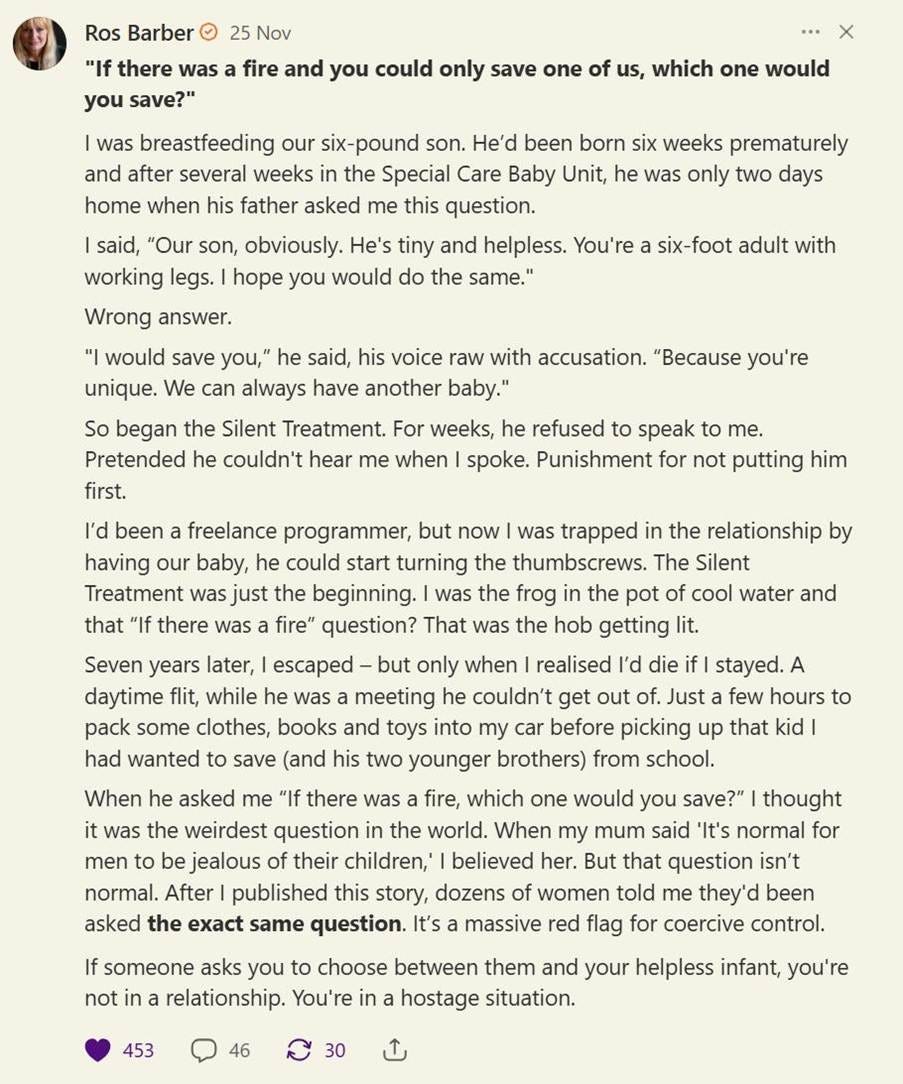
Award winning novelist and Substack writer Ros Barber has spoken openly and candidly about her experience of domestic abuse. In one of her notes, she shares an experience that captures the true nature of an abuser’s loyalty test. While she was breastfeeding their newborn baby, her partner asked who she would save if there were a fire and she could only choose one of them. She answered instinctively that she would save their baby, who was tiny and completely dependent on her.
The result was weeks of his silence and withdrawal, a form of punishment driven by the expectation that he should hold the central place in her world.
Loyalty tests are not only driven by insecurity or jealousy, although those feelings are often present. They reflect a particular way of thinking about relationships, organised around control, entitlement, and the expectation of emotional priority, rather than mutual care.
How Loyalty Is Defined in the Abusive Mindset
In a healthy relationship, loyalty is built through trust, reliability, and emotional safety. Both partners understand that each person has their own life, their own responsibilities, and their own relationships outside the partnership. Dedicating time to your child, your work, your family, or your wellbeing is seen as normal and reasonable. It does not threaten the relationship because the connection is not based on ownership.
In the abusive mindset, loyalty is defined very differently. Loyalty means priority, and priority means being placed above everyone and everything else. The abusive partner expects to be the central focus of your emotional world, and any shift in attention or energy can feel threatening to them. They don’t view your independence as healthy autonomy but as growing distance. They perceive outside relationships as competition rather than support and community. Your separate needs, preferences, or commitments are interpreted as signs that their control is weakening.
This way of thinking is often rigid and black and white. Situations are framed as a choice between loyalty to them and loyalty to someone or something else, rather than recognising that multiple relationships and responsibilities can coexist. Choosing your child is seen as choosing against them. Spending time with family is interpreted as caring more about them. Pursuing your work, your friendships, or your own interests becomes evidence that they are no longer your priority.
This is why situations that would seem ordinary in most relationships can trigger strong reactions in controlling ones. When you make a decision that does not centre them, they do not simply see a practical choice. They see a message about where they stand. Loyalty tests are a way of forcing that message into the open so they can assess whether you still belong within their sphere of control.
Within this mindset, each test becomes a checkpoint in the relationship, and a way of confirming that your priorities continue to revolve around them. If your response reinforces their sense of control, the relationship temporarily settles. If your response suggests independence, the abuser works to pull you back into line through anger, withdrawal, guilt, or intimidation.
These reactions teach you that choosing yourself, or choosing anything outside the relationship, comes at a cost. Eventually, you begin to anticipate the consequences and adjust your behaviour in order to keep the peace and avoid the emotional fallout.
When a Question Isn’t Just a Question
Loyalty tests often appear as emotional questions, hypothetical scenarios, or difficult dilemmas where you are asked to demonstrate your commitment. They may sound casual, joking, or just theoretical at first, but the situation quietly places you in a position where your priorities are being measured.
The surface issue might involve family, friends, work, opportunities, or even your children. But the deeper question is always about how far you will you go to put them first and how much of your own life you are willing to give up for them.
One example of this dynamic appeared in my own marriage during what initially felt like a light, almost playful conversation. My husband had been reading an article about Elon Musk’s plans to build a self-sustaining city on Mars. Smiling, he asked me whether I would go with him if he were selected, or whether I would stay on Earth. The way he asked it made the situation feel like a joke about a distant and unlikely future, so I laughed and said, “Earth of course. I’m quite happy here, thank you.”
The smile disappeared from his face almost immediately. What had felt like a casual moment shifted into something tense and serious. His mood changed abruptly, and he began insulting me, telling me how “forward thinking” he was and how “behind” and boring I was, that I never wanted to try new things and that I didn’t care about him. He then said that if I wouldn’t go with him, he would simply take our child and go without me.
The conversation was no longer about a far-off planet or an imaginary scenario. It had become a test of whether I would abandon everything familiar, stable, and meaningful in my life in order to follow him.
There was a clear contradiction in this expectation. The future he was describing involved him leaving his life, his family, and our relationship in pursuit of his own ambitions, yet my reluctance to abandon my world in order to follow him was treated as selfishness and disloyalty.
This is typical of the double standards in abusive relationships. They see their freedom to pursue their own desires as natural and justified, while your independence is framed as being selfish, uncaring, and evidence that you don’t prioritise the relationship.
When the Threat is Your Child
Ros Barber’s example highlights another pattern that many survivors recognise, which is the way an abusive partner may experience a child as a threat. The arrival of a baby fundamentally changes the emotional landscape of a relationship. Time, attention, and emotional energy are now directed toward a vulnerable human being whose needs are immediate, constant, and cannot be postponed or negotiated.
For a partner who expects to remain the central focus at all times, this shift can feel like they are losing their place. The child is not simply seen as a new family member, but as a rival for attention, care, and emotional priority. This helps to explain why abuse often escalates during pregnancy and in the early months after a baby is born. The increased demands on the mother, combined with her reduced availability to meet the partner’s emotional needs, can intensify their sense that control is slipping.
Loyalty tests that involve choosing between a partner and a child are an extreme expression of this dynamic. They go beyond jealousy or insecurity. They reflect an underlying expectation that they should come first, even over the safety, vulnerability, and basic needs of a dependent child. In this mindset, any shift in attention away from them is experienced as rejection, and the purpose of the test is to reassert their position at the centre, even when the alternative is unreasonable, unsafe, or harmful.
How Loyalty Tests Narrow Your World
What makes loyalty tests so effective within abusive dynamics is that they are framed in emotional terms that make resistance feel unkind or disloyal. They may say that they simply want to feel important to you, that they are afraid of losing you, or that your choices make them feel pushed aside. When your decisions are described as hurtful, selfish, or evidence that you do not care enough, the focus shifts away from whether the situation is reasonable and onto your responsibility to protect their feelings.
You begin to feel that maintaining peace in the relationship requires you to limit your independence, your relationships, or your opportunities. Decisions that would once have felt normal begin to feel risky. Seeing friends, spending time with family, or pursuing your own interests can start to feel like something that needs to be explained, negotiated, or justified in advance.
This is how loyalty tests gradually reshape the boundaries of your life. Each incident reinforces the idea that stability depends on minimising anything that exists outside the relationship. Slowly, without any explicit rule being stated, your world becomes smaller. External connections, interests, and sources of support begin to fall away, leaving the relationship at the centre of your emotional and practical decision making.
Small Tests That Become a System of Control
Loyalty tests often appear early in coercive dynamics and tend to continue throughout the relationship in different forms. Each one marks a point where your autonomy is challenged and where the boundaries of control are quietly pushed further. These moments accumulate, expanding the expectation that your choices, priorities, and emotional energy should increasingly revolve around your partner.
When someone repeatedly places you in situations where you are expected to choose between them and your child, your family, your friends, your work, or your own wellbeing, the issue is not insecurity or a simple need for reassurance. It reflects a mindset in which your independence is experienced as a threat, and your loyalty is judged by how much of yourself you are willing to give up in order to maintain the relationship.
Healthy relationships allow space for multiple sources of meaning, connection, and responsibility. Abusive relationships move in the opposite direction. They depend on your world becoming smaller, quieter, and increasingly centred around your partner’s needs, emotions, and expectations.
When loyalty is demanded through tests, emotional pressure, or punishment, what is being measured is not love, but compliance. When someone repeatedly asks you to choose them over your wellbeing, your support system, or your reality, the question is no longer about loyalty. It is about control.
Special thanks to Ros Barber for allowing me to share her experience as part of this article. You can find her Substack page here.
Related post:
This article really put things in perspective for me. I went above and beyond for my husband and I remember, when we started IVF and I was in pain from the meds and procedures, he became really demanding because his needs were not a priority for the first time. I remember telling him that from now on, he can't be the centre of the universe. Honestly, I see now that's the moment when his behavior changed for the worse.
Beautifully written. I'm a domestic abuse/coercive control expert based in MA, and I really appreciate your work.