

Red Flag Decoder: “You’re Too Materialistic for Your Age”
When criticism becomes a way to shame, diminish, and psychologically redefine you.


The Red Flag Decoder series takes real conversations, emails, and text exchanges drawn from across the internet. Each example is fully anonymised, with identifying details removed. I break down what is really being said beneath the surface, highlighting the red flags and the tactics at play, so you can recognise them for what they are.
Background Context
This is one excerpt from a much longer two-page email sent by an abusive partner to his girlfriend. Throughout the email, he repeatedly criticises her personality, character, values, and behaviour, positioning himself as morally superior while reframing ordinary things she did as evidence of serious personal flaws.
In this section, he focuses on gifts and items she had bought for herself, turning her jewellery and belongings into proof that she is shallow, status driven, and intentionally trying to humiliate or exclude him.
The Message
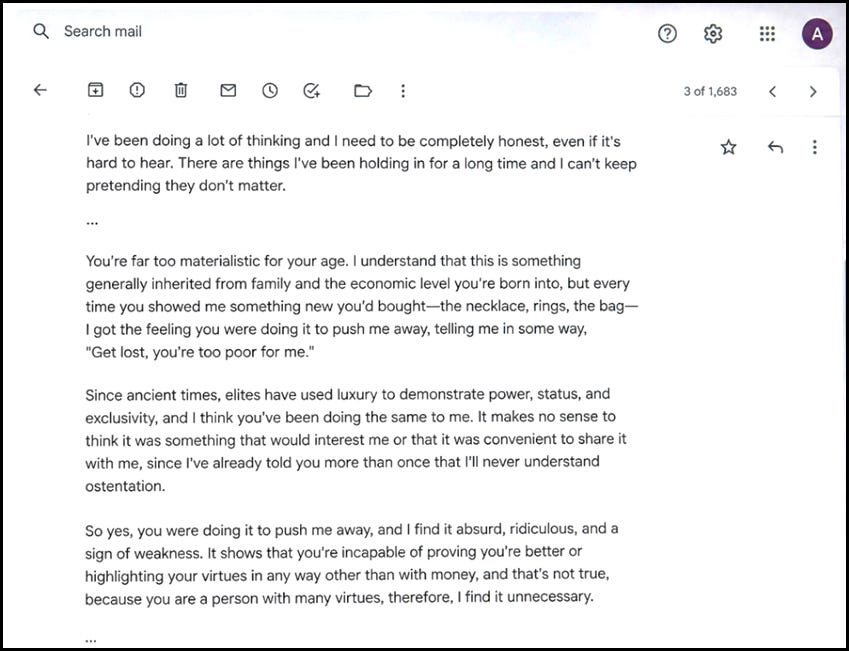
The Red Flags
Pathologising ordinary behaviour
This person takes completely normal behaviour, buying jewellery, bags, or personal items, and reframes it as something psychologically revealing and morally questionable. Abusers often turn everyday actions into evidence of supposed flaws.
Assigning hostile motives to innocent actions
“I got the feeling you were doing it to push me away” is assigning intention without evidence. Rather than accepting that she may simply have wanted to show him something she liked, he interprets it as a deliberate act designed to wound or reject him. This forces her into a position where she must defend motives she never had.
Reframing her behaviour as cruel or exclusionary
“Telling me in some way, ‘Get lost, you’re too poor for me’” creates an extreme interpretation of something that likely had nothing to do with him at all. Abusers often assign harmful motives to innocent actions, forcing the other person to defend intentions they never had, and to stop doing things that trigger their insecurity.
Using intellectualisation to give control more authority
“Since ancient times, elites have used luxury to demonstrate power, status, and exclusivity” turns his personal insecurity into something dressed up as historical or sociological analysis. Abusers often use over intellectualised language to make their accusations sound objective, insightful, or deeply reasoned rather than emotionally reactive.
Positioning themselves as morally superior
“I’ve already told you more than once that I’ll never understand ostentation” places themselves in the role of someone with deeper values and greater authenticity. Abusers often contrast themselves against a supposedly shallow or flawed partner in order to elevate themselves within the relationship.
Turning confidence or self-expression into a character flaw
“I find it absurd, ridiculous, and a sign of weakness” reframes her self-expression and enjoyment of personal belongings as evidence of some deficiency. This creates confusion around what is acceptable to enjoy, express, or feel proud of.
Undermining self-esteem while appearing complimentary
“You are a person with many virtues” softens the attack and makes the criticism feel more reasonable or balanced. Abusers often insert compliments into degrading messages because it reduces the likelihood that the recipient will fully recognise the cruelty or manipulation underneath.
Creating a no-win dynamic
The message attacks her for supposedly using material things to demonstrate value, while simultaneously claiming she has many virtues beyond those things. This creates an impossible standard where her actions are interpreted negatively regardless of what she does.
Projecting insecurity while disguising it as insight
The message is saturated with his own feelings of inadequacy and insecurity, but instead of owning those emotions, he presents them as accurate observations about her character. Abusers often transform their personal insecurities into accusations, making the other person carry responsibility for feelings that originate within them.
The Trap
Messages like this can feel strangely persuasive at first, especially because they are written with so much certainty and detail. The accusations are layered with analysis, interpretation, and emotional reasoning, which can make it feel as though the person has thought deeply about who you are and what your behaviour means.
You may start questioning yourself. You may begin wondering whether ordinary things you enjoy are somehow selfish, shallow, insensitive, or revealing something negative about your character. You may find yourself becoming more careful about what you share, what you buy, what you express excitement about, or how visible your happiness is around them.
That is where the control begins to deepen. The issue is no longer the object itself. It becomes the meaning they attach to it and the version of you they construct around it. You may begin shrinking parts of yourself simply to avoid being misread, criticised, or psychologically dissected.
This is one of the ways emotional abuse operates. The abuser positions themselves as the interpreter of your motives, your personality, your morality, and even your identity. Gradually, your own understanding of yourself starts to lose authority.
What’s True
Buying something for yourself does not make you superficial or materialistic, and sharing something you are happy about is not arrogance, manipulation, or weakness.
Someone feeling insecure about your choices does not mean you are doing something wrong.
You are allowed to:
Enjoy things without defending your character
Express yourself without having your motives rewritten
Have confidence, taste, joy, or pride without it being framed as a moral failing
Trust your own intentions over someone else’s distorted interpretation of them
Someone can feel insecure, uncomfortable, or intimidated. But those feelings do not give them the right to redefine who you are.
You may also like:
"You're far too materialistic for your age..." Right there establishes the hierarchy. The opening of the letter first positions him as authority and then he swoops in for the kill to establish the ranking ... "you are beneath me and must obey". It just goes downhill from there after destabilizing the receiver so the rest of the letter criticizing her is absorbed with full impact.
And once again, I’m having flashbacks. His move has two parts. First, anything she enjoys is a sign of her morally defective nature. He’s attacking her for being materialistic, but if she enjoyed something else, he would find a way that that was a sign of her moral defects too. The real problem is that she is enjoying anything that he doesn’t control. And eventually, the problem is that she is enjoying anything. Because it means she has an independent life and he doesn’t want that.
The second part of his move is that the thing she enjoys is something she is deliberately using to separate herself from him and make him feel bad. He is imputing a malicious motive. But again he could do that with anything. She likes going for a long walks? Is she just trying to get away from him? She likes reading books? Is it because she doesn’t want to pay attention to him?
So the thing she likes is bad, and she’s using it maliciously to make him feel bad. Thus she is bad and he is morally superior twice.
I learned pretty fast not to visibly enjoy anything.