

8 Ways Victim-Blaming Showed Up When I Shared My Story of Coercive Control
Plus a Victim-Blaming Response Guide to help you recognise these narratives and decide how to respond.

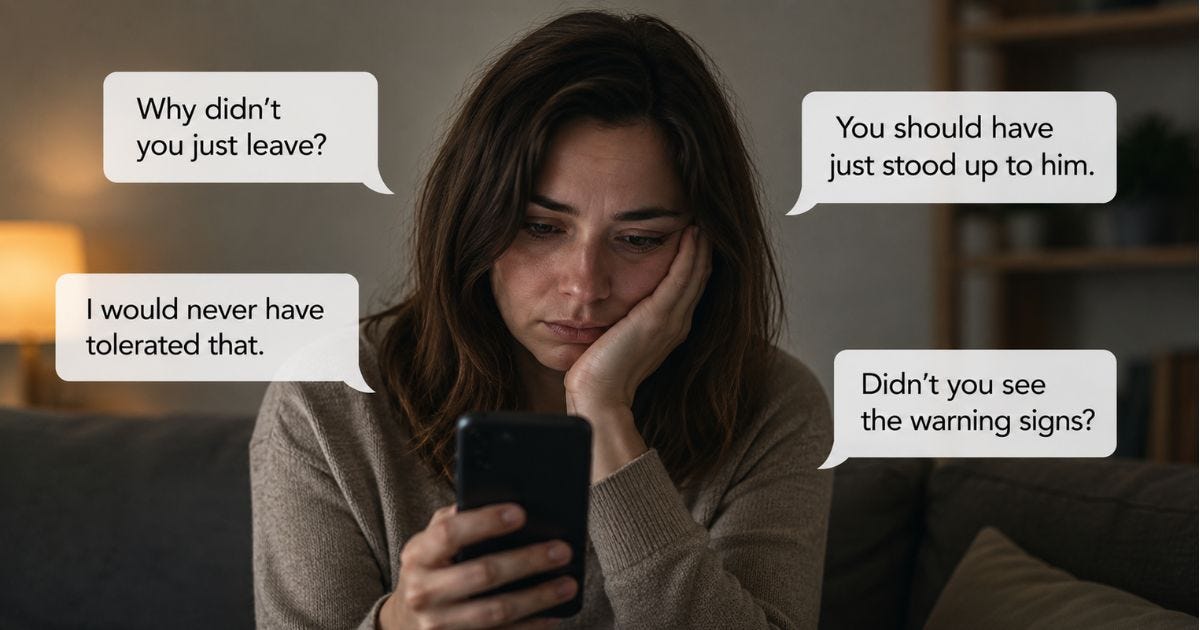
What you’ll find in this article
Eight common forms of victim-blaming and how they shift responsibility away from the abuser.
Why “I would have…” and “you should have…” responses misunderstand the reality of coercive control.
How victims are blamed for staying, allowing the abuse, choosing the wrong partner or failing to resist.
How victim-blaming can create the illusion that abuse can be prevented through better choices, greater strength or assertiveness.
How to cope with victim-blaming and decide whether you want to respond.
A printable Victim-Blaming Response Guide to help you recognise these narratives and choose how to respond.
What Happened When I Shared a Personal Story About Coercive Control
Recently, I shared a personal story on social media to illustrate how coercive control can shape a person’s behaviour without the abuser ever issuing an explicit rule or command. Many of you may have already seen the post, but I’ve included the full account below for context.
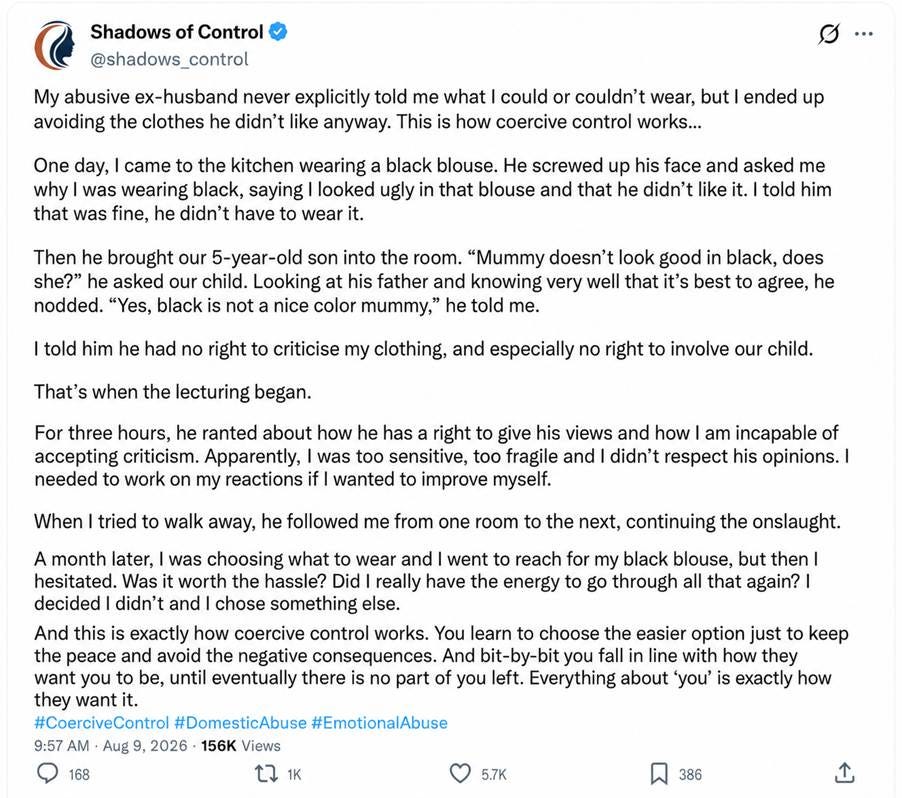
I shared the story to demonstrate something important about coercive control. An abuser can control another person’s behaviour without issuing an explicit command. They can make the consequences of a particular choice so unpleasant that eventually the person starts avoiding that choice themselves.
Many survivors immediately recognised what I was describing because they had experienced something similar, and many shared their own stories in the comments. But alongside those responses came another set of comments that were equally revealing, showing just how deeply victim-blaming narratives remain embedded in the way people understand and respond to abuse.
Some comments were openly hostile and accusatory. Many people confidently stated what they would have done in my position, while others told me what I should have done differently. Some blamed me for choosing the wrong husband, accepting the abuse, allowing myself to be controlled, or failing to leave sooner. The wording varied, but the focus remained remarkably consistent: attention shifted away from the person choosing to abuse and towards the person trying to survive that abuse.
It is interesting to consider why, when somebody describes what an abuser did, some people so quickly turn their attention to the victim and begin questioning their behaviour.
Why didn’t you leave?
Why didn’t you fight back?
Why did you do what he said?
Why did you marry him?
Why didn’t you recognise the red flags?
Why didn’t you choose better?
Why did you allow it?
Each question searches for something the victim could have done to prevent, stop or escape the abuse. Victim-blaming rewrites abuse as a problem the victim could have solved if only they had acted differently
The responses to my post offer a useful case study in victim-blaming because eight distinct forms appeared within a single discussion, many of which come up repeatedly in wider conversations about abuse. Looking at them individually helps show how victim-blaming can take very different forms while repeatedly shifting responsibility away from the abuser.
1. Judging the Victim Through “I Would Have” Comments
One of the most common responses was some version of what the commenter believed they would have done in my position.
“I would have worn black every day until he was served the divorce papers.”
“I would have dressed only in black from the next day. Heck I would have gotten a room painted black.”
“I would have” statements compare a victim with an imagined version of the commenter. The underlying message is often that I would have been stronger, more defiant or less willing to tolerate this. Yet the commenter is imagining how they would respond from their current position of freedom and safety, rather than from within the coercive conditions a victim was actually living in.
One comment was particularly striking: “I would have worn that shirt until it fell in taters off my body. He would have literally killed me.”
The commenter may simply have been expressing anger at his behaviour and how strongly they would have wanted to resist. Yet taken literally, they are saying they would have continued wearing the blouse even if their husband killed them for doing it. That is a shocking standard against which to judge a survivor’s response, especially when some women are killed because they resist an abuser, while others face serious violence or retaliation involving their children.
Nobody can know how they would behave in another person’s circumstances while viewing those circumstances safely from the outside. When someone says, “I would have worn the blouse anyway,” they imagine an isolated choice about clothing while removing the consequences that made that choice unsafe or costly in the first place.
2. Telling Victims What They “Should Have” Done
Closely related to the “I would have” responses are comments that tell the victim what they should have done instead.
“You should have worn that black blouse for a month straight til he learned his lesson.”
“And you should have packed your bags and taken your son away the very first time he showed you that side of himself.”
Others expressed the same idea as general advice:
“Women need to learn to support themselves and leave bad situations.”
“Why on earth would you try to survive abuse. The very first time you get out.”
“You should have…” directly instructs a victim about what they supposedly did wrong. The underlying message is: There was a correct course of action available to you, and you failed to take it. The commenter identifies what they believe was the right response and judges the victim against it, while also implying that following their advice would have prevented, stopped or ended the abuse.
The first two comments also show how simplistic that advice can become. Wearing the blouse every day “til he learned his lesson” assumes that greater defiance would teach an abuser to stop trying to control you. In reality, resistance can lead an abuser to increase the consequences. Telling someone they “should have packed” and taken their child away assumes they were free to do so safely and immediately, without knowing anything about the risks or circumstances they were dealing with.
Advice given from outside a relationship with an abuser can make the solution appear straightforward because the person giving it never has to experience the consequences of following it.
3. Directly Blaming Victims for “Allowing” the Abuse
Some comments went further than suggesting what I should have done differently. They directly blamed me for failing to stop the abuse or suggested that my responses allowed it to continue.
“I blame you for that. Practice saying No. ie, ‘I’ll wear whatever I want, whenever I want, however I want’, catch my drift?”
“If you obey his bullying, you are a volunteer slave.”
“I don’t blame the victim for the abuse, I blame them for not stopping it.”
“A person cannot treat you in a way you don’t accept.”
“Stop telling yourself there were no warning signs. There were... They are always there. Every time you let him hurt you he hates you a bit more.”
These types of statements present a victim as someone who has the power to stop the abuse and fails to use it. They also turn compliance into evidence that the victim accepted what the abuser was doing.
There can be something reassuring about this belief. If people convince themselves that victims become trapped because they tolerate too much or fail to stand up for themselves, they can convince themselves that it would never happen to them. Their own strength and judgement become a form of imagined protection.
Coercive control challenges that sense of immunity. Strong, assertive and independent people can still experience coercion because the abuser creates consequences for resistance and uses those consequences to shape behaviour. A victim may technically have a choice available while knowing that exercising it could bring punishment or escalation.
