

Red Flag Decoder: "Why are you friends with a guy when you know it upsets me?"


The Red Flag Decoder series takes real conversations, emails, and text exchanges drawn from across the internet and from my own lived experience. Each example is fully anonymised, with identifying details removed. I break down what is really being said beneath the surface, highlighting the red flags and the tactics at play, so you can recognise them for what they are.
This is the first article in the series, and I want to say a little more about what it is for. The goal is to help you understand abusive communication and the manipulative strategies that sit beneath it, the kind that can feel confusing, reasonable, or even justified in the moment. By breaking down real exchanges, I want to show you how to read beneath the words so you can see what is actually being done, not just what is being said. Each piece will highlight the red flags within the message, unpack the trap it creates, and bring you back to what is true, so you can reconnect with your own sense of clarity and reality.
Background Context
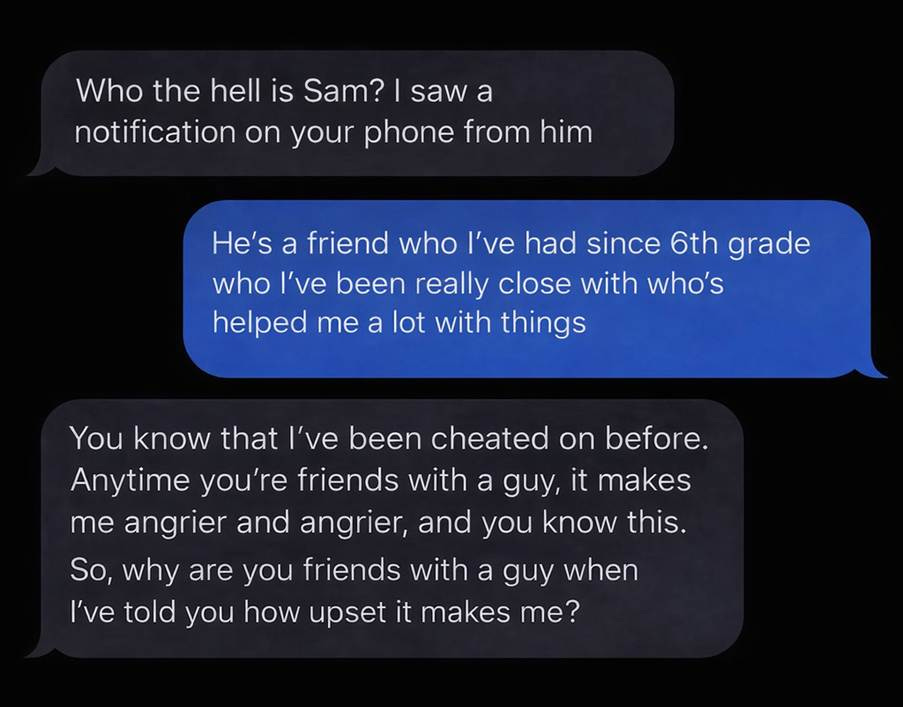
This is a real text message exchange between two people in a relationship. One partner questions the other after seeing a notification from a male friend, and the conversation shifts from a simple question into pressure around who they are allowed to have in their life.
The Message
The Red Flags
Turning their past into your responsibility
“You know that I’ve been cheated on before” is this person using their past to justify control over your present. Rather than working through their trust issues, they place the expectation on you to prevent those feelings from being triggered. This shifts the burden of their healing onto your behaviour, and your freedom becomes limited by something you did not cause and had no part in.
Creating a rule you are expected to follow
There is no direct instruction, but “anytime you’re friends with a guy” reveals the scope of what this person considers a problem - not this friendship specifically, but male friendships as a category. This is how control often begins, through implied expectations rather than explicit demands. Abusers establish these unspoken rules gradually, and they become things you feel you have to comply with to avoid conflict, even though they were never openly agreed or negotiated.
Escalating emotion to create pressure
“It makes me angrier and angrier” introduces a sense of rising intensity. This person uses escalating emotion to signal that the situation will continue to build unless something changes. That pressure pushes you to act quickly, to give something up, to do whatever reduces the tension rather than what feels right to you.
Positioning you as knowingly causing harm
“You know this” is this person reframing your behaviour as something you are doing to them, rather than a normal part of your life. It suggests that you are aware of the impact and choosing to continue anyway. Abusers use this framing to generate guilt and create a sense that you are in the wrong, even when your behaviour is entirely reasonable.
Expecting compliance with an unspoken rule
“Why are you friends with a guy when I’ve told you how upset it makes me?” is this person suggesting the issue has already been raised and should have been acted on. There is an expectation that you should have already adjusted your behaviour, specifically by not being friends with a guy. This frames your continued choice as a failure to comply, rather than a valid decision, and reinforces the idea that their discomfort should dictate your actions.
The Trap
Messages like this often feel understandable on the surface. You can see the hurt behind them and the history they are drawing from, and it can feel like you are simply being asked to be considerate, to offer reassurance, or to make a small adjustment for the sake of the relationship.
Because of that, you may find yourself explaining more than you need to, softening your position, and adjusting your behaviour around what will keep things calm rather than what feels right to you. You begin to anticipate what might upset them before it happens, and it starts to feel easier to change than to hold your ground.
That is how the dynamic takes hold. Abusers don’t need force. Pressure, emotion, and the slow reshaping of what feels acceptable are enough.
What’s True
Being a good partner means being trustworthy, honest, and respectful. It does not mean shrinking your life to manage someone else’s fears.
You are allowed to:
Choose your own friendships
Maintain normal, respectful connections
Be trusted without having to constantly prove it
Someone’s pain deserves empathy, but it does give them the right to control your life.
🌿 These conversations grow stronger when we hear from different voices. If this article connects with your experience, you’re warmly invited to share your thoughts below.
“ I get angrier and angrier” is a threat, too. If you keep talking to other guys, I swear I don’t know what I’m going to do, but it will be your fault, because I warned you. The only sensible response to this is “don’t contact me again.” but it’s hard to come up with.
I cut ties with all male friends over this kind of crap because I didn’t want to be the reason they were in danger. In retrospect, if I had instead told them what was going on, they probably would have helped me get away from what became a dangerous situation. Cutting ties with male friends can eliminate options for leaving the relationship later. Like when I lost my housing due to his abuse and then had to ask him to help me move my furniture (which then gave him access to my new place). Ladies, keep your male friends!