

Red Flag Decoder: “So Me Caring Is Too Much for You?”
When “too much, too soon” is dressed up as care.


The Red Flag Decoder series takes real conversations, emails, and text exchanges drawn from across the internet and from my own lived experience. Each example is fully anonymised, with identifying details removed. I break down what is really being said beneath the surface and highlight the red flags and the tactics at play.
Background Context
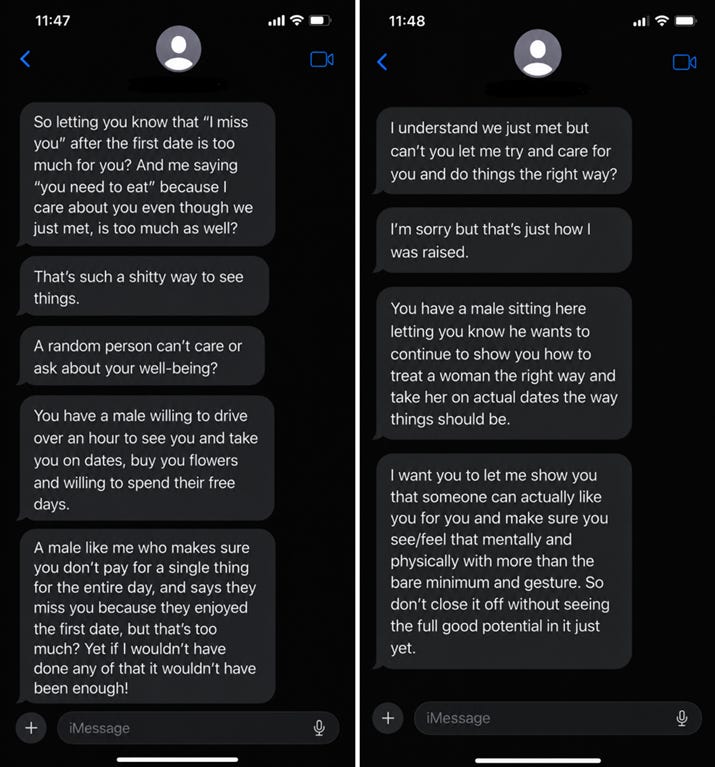
These text messages come from a man who went on a first date with a woman and came on very strong from the start. He packed the date with intensity, attention, and effort and treated that as proof of how much he cared. After the date he told her he already missed her, and when she said his level of attention felt too much and that she did not want to continue, he sent the texts shown here.
The Message
The Red Flags
Framing intensity as care
“So me caring is too much for you?” sets the tone from the start. He defines his behaviour as care and presents that definition as the only way to see it, which leaves very little room for her experience. When she feels overwhelmed, he treats her reaction as a refusal of kindness instead of a natural response to intensity.
Masking control as care
“Me saying ‘you need to eat’ because I care about you” shows he was directing her behaviour very early on. He placed himself in a position of authority over her body and choices, labelling his control as care so it carries a positive meaning. This makes it harder for her to question it, and when she resists, he treats that resistance as a problem to solve.
Dismissing her response
“That’s such a shitty way to see things” shows him judging her reaction. He shifts the focus away from how his behaviour feels for her and onto her perspective, which he presents as flawed. By doing this, he keeps his behaviour in the right and pushes her toward self-doubt.
Normalising boundary crossing
“A random person can’t care or ask about your well-being?” shows him redefining what counts as reasonable. He presents early intensity as something people should accept, which blurs the line between genuine care and intrusion. This framing places pressure on her to accept behaviour that already feels uncomfortable.
Using generosity to create obligation
“You have a male willing to drive over an hour… buy you flowers… make sure you don’t pay for a single thing” shows him listing his actions as if they earn him something from her. He presents these gestures as proof that he deserves a particular response, which builds a sense of debt and expectation. She can end up feeling as though she owes him more time, attention, or emotional access simply because he chose to do those things.
Creating a no-win dynamic
“That’s too much? Yet if I wouldn’t have done any of that it wouldn’t have been enough” shows him closing off any way for her to respond that feels ok for her. He presents both options as wrong, so she looks unreasonable whether she accepts his intensity or rejects it. This kind of double bind creates confusion and makes it harder for her to trust her own judgement.
Positioning himself as the standard
“A male like me” shows him elevating himself as the benchmark. He defines his behaviour as the right way to act on a date and treats that as a fact. When he does this, any disagreement can start to feel like a failure on her part to recognise a “good man” rather than a valid response to discomfort.
Rewriting her boundaries as rejection
“You can’t let me try and care for you” shows him reframing her boundaries as something she is doing to him. He presents her limits as blocking something positive, which casts her in the role of the person who is being unfair or closed off. This puts pressure on her to lower her boundaries to protect his feelings instead of protecting her own safety and comfort.
Using upbringing to justify behaviour
“That’s just how I was raised” shows him presenting his behaviour as morally grounded. He uses his upbringing as a shield, so his actions start to look like principles rather than choices. This move directs her toward acceptance instead of questioning, because challenging his behaviour can start to feel like challenging his values or family.
Claiming authority over relationships
“The way things should be” shows him claiming authority over how dates are meant to look. He places his version of dating and care above hers and treats it as the standard everyone should follow. When he does this, her own needs and expectations can start to feel less legitimate.
Accelerating emotional intensity
Statements like “I miss you” after a first date show him pushing the connection forward very quickly. He increases emotional intensity before trust has had time to develop, which creates pressure on her to respond at the same speed. This pace can leave her with little space to listen to her instincts or to see how he behaves over time.
Refusing to accept her choice
“Don’t close it off without seeing the full good potential” shows him refusing to accept her decision and trying to reopen a choice she has already made. He pulls her attention away from the clear ‘No’ she has given and toward an imagined future where he still gets another chance. He pushes her to reconsider after she has said she does not want to continue, which undermines her right to end the connection on her terms.
The Trap
Messages like this can feel compelling because the abuser wraps everything in the language of effort and care. She can see the time he has spent, the gestures he has chosen, and the intention he claims to have, and that can make his behaviour look generous on the surface.
This kind of intense attention and praise early on is often called love bombing, where an abuser uses big displays of care to create fast attachment and then uses that attachment to gain control.
Driving long distances, buying flowers, paying for everything, and expressing strong feelings early on can create a strong sense of being valued and chosen. She may feel as though someone is prioritising her in a way she has not experienced before, which can make it harder to name the discomfort underneath.
The abuser uses that intensity to set the pace and to define what the connection should look like. He moves the relationship forward quickly and expects her to keep up, and when her response does not match his level of investment, he introduces guilt and frustration. He questions her reaction, treats it as a problem, and urges her to adjust.
She may start to question herself and her sense of timing. She may doubt her own pace and feel pressure to meet him where he is, even though something in her feels uneasy. Her boundaries can begin to feel like something she has to justify, and her comfort can start to feel less important than proving that she appreciates his effort.
This is how control can take hold in a situation that is presented as romance or care. The abuser uses attention, generosity, and emotional intensity to shape the dynamic until continuing to date him feels easier than holding her ground.
What’s True
A loving partner respects your pace and your boundaries.
Generosity does not create entitlement to your time, your body, or your feelings. You keep the right to decide what feels right for you at every stage, whatever someone else has chosen to give or do.
You are allowed to:
Take things at your own pace and to listen when intensity feels overwhelming.
Set boundaries without explaining your reasons for them.
Make decisions based on how the situation is affecting you, rather than how the other person might feel about it.
Someone can feel interested and invested without pushing you, overriding your instincts, or treating your limits as a personal attack.
You can choose how you respond and how much access someone has to you, and you can step back from any dynamic that asks you to trade away your comfort for someone else’s approval.
Thanks for helping me realize that I was not crazy for being stressed when I received those kinds of messages!
Even though it sucks knowing I faced this without realizing it, I at least will recognize the red flag clearly if I’m ever in the situation again. Looking back, I remember being uncomfortable but had tons of ways for rationalizing or justifying it. But also didn’t really know *what* was wrong about it. Thanks for breaking it down cause it really helps to have this insight.