The Cycle of Abuse: How to Recognise the Patterns + Downloadable Worksheet
A clear guide to making sense of repeating patterns in your relationship


What you’ll find in this article
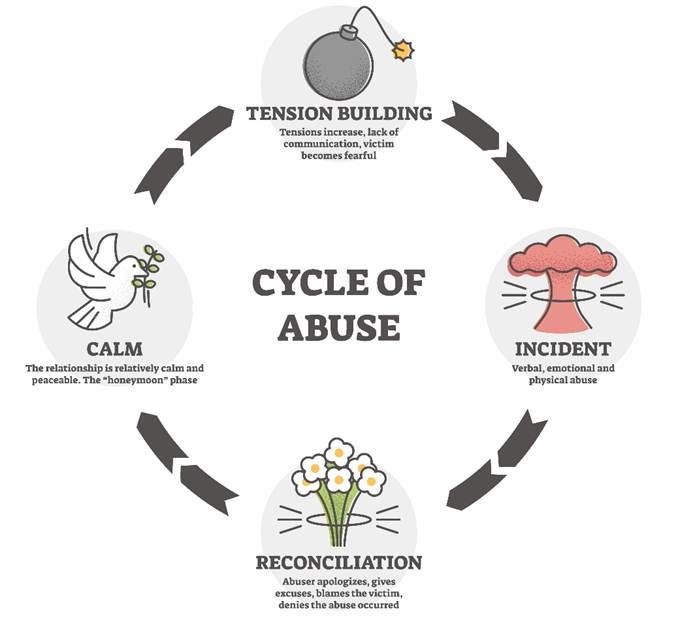
A clear explanation of the cycle of abuse and how the four phases can show up in abusive relationships.
My own experience of living through these patterns, and what they felt like from the inside.
Insight into why this pattern can be so difficult to recognise while you are in it.
A look at where the model helps and where it falls short, including how abuse can become constant rather than cyclical.
A reflective worksheet to help you map your own experience and recognise patterns in your own words.
One of the reasons abuse can be so difficult to recognise is that it often does not feel constant. Many survivors describe their relationship as moving through repeating phases, where tension builds, something happens, then the abuser offers apologies or explanations, followed by a period where things seem calm again. This pattern is often referred to as the cycle of abuse.
For many survivors, it is the first framework that brings a sense of recognition. But like all models, it is a simplification.
When I first learned about it, a lot began to make sense in a way it had not before. I could see why I had spent years feeling confused, hopeful, frightened, relieved, and then confused all over again. Moments that had felt isolated at the time started to take on a different meaning when I viewed them as part of something that repeated.
At the same time, I now understand that this model does not capture every abusive relationship. Many do not follow a clear sequence, and abuse is often far more constant and complex than any model can fully explain. Still, for many survivors, the cycle offers a first way of recognising patterns that have been difficult to name.
What Is the Cycle of Abuse?
The cycle of abuse was first introduced in 1979 by psychologist Lenore Walker in her book The Battered Woman. She originally described three phases: tension building, an acute incident, and a honeymoon phase. The model has since been expanded into four stages that are more commonly used today: tension building, incident, reconciliation, and calm.
This cycle describes a pattern that can repeat many times within a relationship. For some, it unfolds over months. For others, it can happen within days or even within the same day. The length and intensity can vary, but the pattern itself can remain recognisable.
Understanding these phases can help bring clarity to something that has often felt unpredictable and confusing.