

Dr. Niyati on How Culture, Family, and Community Keep Women Trapped in Abuse


Welcome to Expert Insights, and to this conversation.
This piece marks the beginning of something I have been wanting to bring into this space for a long time. It is the first in a new series for members, where I speak with therapists, trauma-informed psychologists, and professionals who work closely with victims and survivors of domestic abuse and coercive control, as well as writers and specialists whose work intersects with these experiences.
The intention behind this series is simple. So many of you have shared your stories, your questions, and the parts that still feel confusing even long after leaving. This is a way of bringing in voices from people who see these patterns every day in clinical, research, and lived contexts, and shaping those conversations around what survivors actually go through, and what genuinely helps those navigating abuse and its aftermath.
I could not think of a more fitting person to begin this series with than Dr. Niyati Kadakia.
Dr. Niyati is a Doctor of Clinical Psychology, Associate Clinical Psychologist, and the creator of The Braided Path™ - a culturally grounded model of post-traumatic growth designed to support women in reclaiming voice, identity, agency, and meaning after adversity, harm, relational and gender based violence.
Her work sits at the intersection of psychology, creativity, culture, and feminist-informed trauma understanding, drawing on an interdisciplinary background spanning clinical psychology, neuroscience, expressive arts, and somatic practice. Importantly, she also writes and speaks from lived experience, bringing a depth and clarity that bridges clinical insight with the lived realities of trauma, healing, and transformation.
Alongside her clinical and research work, Dr. Niyati is an expressive arts practitioner, artist, poet, and registered trauma-informed yoga and meditation teacher. She has served as an Art Commissioner for the City of Encinitas (California) , serves as Faculty for the Global Arts in Medicine Fellowship (GAIM) and as a Board Member of the Breaking the Chains Foundation. Her work spans the United States and India, integrating culturally grounded approaches to trauma recovery, post-traumatic growth, and creative healing.
Her perspectives and work have been featured on public radio in the United States, including NPR-affiliated KPBS. She is also the author of the Substack newsletter Maitri: Empowerment, Reinvention, and Post-Traumatic Growth, where she explores the intersections of psychology, culture, creativity, resilience, and the human capacity for transformation.
What makes her perspective particularly important is her emphasis on cultural context. Her work challenges the idea that abuse exists only within a relationship between two people, and instead situates it within the wider systems that shape it. Family structures, cultural expectations, gender roles, and community responses are not secondary influences. They are often central to how abuse is maintained, minimised, and misunderstood, and they can profoundly shape a woman’s ability to recognise what is happening and to act on it.
In this conversation, Dr Niyati speaks about how culture, family, and community can keep women trapped in abuse, often in ways that are subtle, normalised, and deeply internalised. She explores what happens psychologically when harm is reframed as duty, when endurance is praised, and when the very systems a woman turns to for support instead reinforce the conditions she is trying to make sense of. It is a perspective that adds an essential layer to how we understand coercive control, and one that many of you will recognise in your own experiences. The conversation opens with how these wider systems shape a woman’s awareness of abuse, and her ability to respond to it.
You speak about abuse not just as something between two people, but something upheld by culture, family, and community. How do you these wider systems shape a woman’s ability to recognise and leave abuse?
Abuse is often framed as an interpersonal issue, but in many cases it is sustained by a broader cultural and relational ecosystem that shapes both perception and response.
From a developmental perspective, women are frequently socialized into roles that prioritize relational harmony, caregiving, and self-sacrifice. Research in gender role socialization and social role theory shows that girls are consistently rewarded for compliance, emotional attunement, and nurturance, while assertiveness and self-prioritization are often discouraged (Gilligan, 1982; Eagly & Wood, 2012). Over time, these expectations become internalized as identity and moral orientation, shaping how women interpret both self and relationship (Chodorow, 1978; Jack, 1991).
This is not abstract for me.
It is informed both by my own lived experience and by years of clinical work with women facing similar challenges. I know firsthand what it is like to spend years negotiating the tension between personal truth and relational obligation to repeatedly question whether to stay or leave, to reorganize parts of oneself around a marriage and family system, and to feel the immense psychological weight of expectations tied to duty, belonging, and responsibility.
What I have learned, both personally and professionally, is that these experiences are rarely unique to one woman or one relationship.
Across cultures, generations, and socioeconomic backgrounds, I have watched remarkably similar themes emerge. Whether a woman is a daughter, wife, daughter-in-law, mother, or caregiver, she is often taught - explicitly or implicitly that preserving relationships, maintaining harmony, and prioritizing the needs of others are central responsibilities.
As a result, many women learn to question themselves before they question the system around them. They may sense that something feels wrong, unsafe, unfair, or deeply painful, yet simultaneously feel responsible for protecting family cohesion, managing the emotions of others, preserving reputation, or maintaining social stability.
Over time, that responsibility becomes more than behavior.
It becomes identity.
And that is why many women are not simply navigating a relationship. They are navigating entire systems of meaning that shape who they believe they are allowed to be.
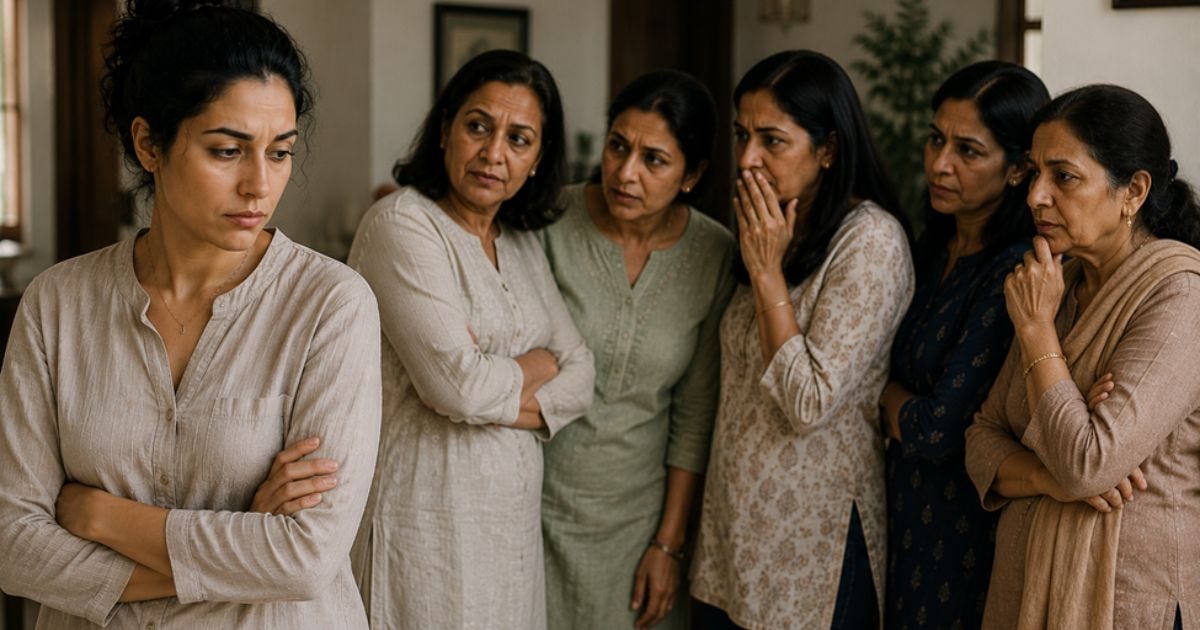
In my clinical work, I see this repeatedly. Women are not simply navigating a relationship. They are carrying the psychological burden of holding families together, protecting reputation, and maintaining cohesion. Many have been taught, explicitly and implicitly, that their role is to absorb strain and prioritize others. So when harm begins, it is often interpreted not as abuse, but as something to manage, endure, or fix.
For example, I work with women who are:
Being verbally demeaned or controlled, but are told to “adjust” because “every marriage has conflict”.
Told to stay in situations purely for ‘family honor’ or social reputation because the consequences are profound and far reaching, often impacting entire family systems.
Managing a partner’s anger or volatility, while being encouraged to be more patient, more understanding, more accommodating.
Discouraged from setting boundaries because it might “disrupt the family” or affect others.
Urged to stay in situations that feel unsafe or deeply misaligned because leaving would bring shame or social scrutiny.
Taking responsibility for repairing the relationship after episodes of harm, because they are seen as the emotional center of the family.
In these dynamics, the locus of responsibility is systematically shifted away from the behavior causing harm and toward the woman’s capacity to tolerate and preserve the system. Over time, distress is internalized - “What do I need to do differently?” - rather than accurately attributed to external harm. This aligns with cognitive frameworks of attributional style and internalization under chronic stress (Abramson, Seligman, & Teasdale, 1978).
It is also important to name that this is NOT about women lacking agency. In fact, I often work with highly capable, educated, and otherwise empowered women who clearly recognize the harm and have the capacity to leave - but do not. Not because they are unable, but because of the powerful cultural and familial narratives that bind them.
The psychological frameworks around abuse - coercive control (Stark, 2007), trauma bonding (Dutton & Painter, 1993), and learned helplessness (Seligman, 1975) - are essential. However, they are not sufficient on their own. Without accounting for cultural context and family systems, we risk decontextualizing the woman’s experience.
Ecological and systems-based models (Bronfenbrenner, 1979) remind us that individual behavior must be understood within nested relational and cultural environments.
Even when a woman recognizes the abuse, there is often a deep, competing need to remain aligned with her cultural identity, preserve belonging, and stay within inherited relational roles. This creates profound internal dissonance - what can be understood as a conflict between internal experience and external expectation (Festinger, 1957; Higgins, 1987):
I can see what is happening clearly
But I cannot act without losing everything that defines me
Clinically, this dissonance manifests in significant ways. I see, and have personally experienced, the psychological impact of this bind - deep depression, chronic anxiety, and in many cases, suicidal ideation. Research on chronic relational trauma and role entrapment shows strong associations with affective dysregulation, identity disturbance, and depressive symptomatology (Herman, 1992; Linehan, 1993; McEwen, 2000). The cost is not only emotional, but neurobiological, as prolonged stress reshapes regulatory systems and threat perception.
Cultural and family structures further reinforce this. In many traditional and semi-traditional contexts, identity itself is relationally organized. Daughters are raised within one family but expected to integrate into another - often marked by symbolic and practical shifts such as name changes, loyalty transitions, and role expectations.
Even in progressive environments, these patterns persist. The son is often positioned as the continuity of the family identity, while the daughter is socialized to adapt. Anthropological and sociological research on kinship and gender roles has long documented these asymmetries in identity continuity and role expectation (Kandiyoti, 1988).
When these early frameworks intersect with dynamics of coercive control - ongoing patterns that restrict autonomy and agency (Stark, 2007) - recognition becomes even more obscured. Behaviors that might otherwise be identified as abusive are normalized within culturally sanctioned narratives of duty, compromise, and adjustment.
Finally, the role of family and community response is critical. When a woman begins to name her experience and is met with minimization or reframing, such as “this is normal,” “don’t overreact,” “think about the family”, it creates what betrayal trauma theory identifies as a secondary injury, where harm is compounded by the failure of trusted systems to acknowledge or protect (Freyd, 1996; Freyd, DePrince, & Zurbriggen, 2001). This social invalidation not only increases psychological distress but also undermines epistemic trust - her ability to rely on her own perception of reality.
This is often where the deepest fracture occurs. Because the very people and structures a woman turns to for support may instead reinforce the conditions that keep her in harm - maintaining the cultural narrative while looking away from the reality.
So the primary barrier is often not leaving - it is recognizing clearly and trusting that recognition.
And even when that clarity is achieved, leaving is not simply a personal decision. It can involve the loss of identity, belonging, and social protection, which aligns with research on social exclusion and its profound psychological impact (Eisenberger & Lieberman, 2004; Baumeister & Leary, 1995).
This is why abuse cannot be fully understood as an individual issue. It must be understood within the cultural and systemic contexts that shape what women are taught to see, tolerate, and carry.
In your experience, how does culture teach women to stay, even when something feels deeply wrong?

Continue reading this post for free, courtesy of Shadows of Control.
 | A guest post by
|